Wednesday, August 21, 2019

Drifter's Vengeance – Max Brand, 1973 [1932] ★½

Playing with Western Conventions

Think “western fiction” and many ideas spring to mind.

Not all are flattering. With an emphasis on action, westerns cater to shorter attention spans. Action is emphasized, dialogue spare. Even more than other genres, plots conform to expected formulas. Outcomes are simpler, too: Even revisionist westerns are tough on bad guys.

Saturday, August 17, 2019

The Art Of Alfred Hitchcock: Fifty Years Of His Motion Pictures – Donald Spoto, 1992 ★★

Sometimes a Bird Is Just a Bird

In the world of film criticism, few directors present target-rich environments like Alfred Hitchcock. You can delve into the stories behind his movies; the often-disturbing if genial persona he crafted both in front of and behind the lens; the evolution of his craft; the signature devices that established a film as distinctly his own.

Or you can do what Donald Spoto does here and point out all the symbolism until you’ve turned some of cinema’s greatest touchstones into amoebas in a microscope.

Sunday, August 11, 2019

"Captains Courageous" – Rudyard Kipling, 1897 ★½

Fish Story Gets Away

The first thing that threw me about this novel when I encountered it as a boy was the title.

Glancing at it, I expected something like the Three Musketeers at sea. It was billed as an adventure tale. Author Rudyard Kipling was known for his war stories, often set in India. How could I have known it was a story about a youngster learning how to become a man by…catching fish?

Sunday, August 4, 2019

The Zimmermann Telegram – Barbara Tuchman, 1958 ★★★

A Man, a Plan, a Telegram

The plan seemed perfect in its simplicity: Take out a prospective enemy in the middle of a global war without moving a single soldier or ship. What could go wrong?

For Imperial Germany in 1916, quite a lot. For the prospective enemy was the United States, the conflict World War I, and the plan used would prove just the lever to move a peace-loving American president to join in the carnage as an ally of Germany’s foes.

Sunday, July 28, 2019

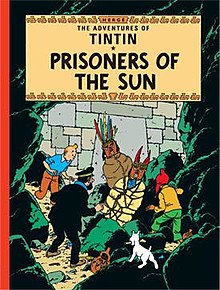
Prisoners Of The Sun – Hergé, 1946-49 ★★

Tintin's Most Overrated Adventure?

Sweeping vistas of the snow-capped Andes. Realistic depictions of ancient Incan architecture and every kind of South American animal you can imagine, from bullish tapirs to ornery llamas. Crypt-like hideaways tucked behind imposing waterfalls.

Prisoners Of The Sun boasts all this splendor and more. Graphically, it is a stepping-up point for “The Adventures Of Tintin” the same way The Blue Lotus had been back when the series was just getting started. Storywise, though, author Hergé is content to put Tintin and his buddies through the motions. That could just be my take, as Prisoners is one of the best-regarded of Tintin books.

Wednesday, July 24, 2019

The Seven Crystal Balls – Hergé, 1943-48 ★★★

Tintin’s Weird Tale

If any installment of the Tintin series had a right to flop, it was this. While author Hergé was writing it, he found himself suddenly unemployed and arrested for Nazi collaboration. Overnight, he went from pop star to criminal. Also, his mother died.

But The Seven Crystal Balls did not flop; just the opposite. It could be argued the book was the best thing to happen not only to “The Adventures Of Tintin” but Franco-Belgian comics; it helped launch a magazine under the “Tintin” banner that became the mothership for a bevy of comic artists and opened a door for Edgar P. Jacobs, a Hergé collaborator who, after his uncredited co-write here, launched his own milestone franchise, “Blake And Mortimer.”

Saturday, July 20, 2019

The Father – August Strindberg, 1887 [Translated by Elizabeth Sprigge] ★½

Throwing Away the Envelope

What would a battle of the sexes look like if participants were less motivated by sexual desire and more by Nietzschean will to power? The Father sets the struggle of man versus woman, or rather husband versus wife, in exactly that context.

Whether the play is valid, illuminating, or entertaining as presented is a different question. I didn’t find it so, but I was born a century after the intended audience. They found this drama convincing enough to help lift its author, August Strindberg, to international fame.