Showing posts with label Elizabethan drama. Show all posts

Sunday, June 7, 2026

All’s Well That Ends Well – William Shakespeare, 1598-1608? ★★★

Stand by Your Man

The verdict on this play over the years can be summed up in a single word: Meh.

Its existence went unnoticed from available evidence until 1623’s publication of the First Folio. Its origins are murky, at least as far as Shakespeare’s composition is concerned. Its performance history is rather slight for a comedy by the Bard; not even a movie adaptation.

Beyond that, it is a comedy that is not that funny and a romance which leaves a bad taste in many mouths. There are many fine things about it, particularly an engaging heroine and a villain who doubles as comic relief. It has an experimental quality about it one can either go with or not, trusting in the title not to be led astray.

Whether it delivers on that title isn’t clearly answered. Since that is the one thing people know about the play going in, let’s look into it.

Saturday, February 28, 2026

Othello – William Shakespeare, c. 1603 ★★★½

Shakespeare's Least-Great Masterpiece

Shakespeare’s tragedies are recognized to be enduring classics above and beyond even the most celebrated literature. Of them, Othello maybe has the strongest case for contemporary resonance. The themes of irrational enmity and racial hatred have certainly kept it fresh.

But the case for Othello doesn’t ring as solidly to me as Shakespeare’s other three top tragedies: Hamlet, MacBeth, and King Lear. The main plot is constrained and deterministic. Its characters are relatively few and mono-dimensional, lacking for life. The comedic interludes are slight to the point of pointlessness. While Shakespeare tragedies deliver a kind of catharsis amid the Act V tears, here you get just bitter silence.

You get a great villain, one of the greatest of all time, and scenes of deep complexity and wit worth turning over in one’s head. But I never enjoy this one like I do the others. It only commands my respect.

Saturday, November 8, 2025

Sir Thomas More – Anthony Munday, Henry Chettle & others, c. 1596-1604 ★½

Shakespeare by Committee

If you accept prevailing wisdom, it is nothing short of a miracle we have this play. It presents a famously controversial episode in British history when deadly turmoil from that controversy still raged. For centuries the play was buried from public view, seemingly lost forever.

Most incredibly, the original play manuscript includes handwritten lines by William Shakespeare, who composed at least most of one scene. Handwriting experts are convinced, anyway; so are many leading Shakespearean scholars.

So why is Sir Thomas More so hard to get excited about? Is it just because the play is mostly not by Shakespeare? Or is it just because it’s mostly not by anyone?

Saturday, June 14, 2025

Troilus And Cressida – William Shakespeare, c. 1601-1602 ★½

Not Giving a Fig

This is a play which leaves many questions. Is it a comedy, a tragedy, or a mash-up? Is it pro-Trojan, pro-Greek, or anti-both? Are we supposed to hate or pity the main female character? What about her beau? And why does it end with everything still in the air?

For me, it may turn on a question bleaker still: Did Shakespeare not care enough to work this into something sharper?

Troilus And Cressida is magnificent in its language, its diversity of tones and contrasts, its philosophical arguments that weave and wend with Hamlet-level depth. As a play, though, it falls way short. I find it a tedious read, lacking focus as it cribs from Homer and Chaucer.

Wednesday, January 1, 2025

Twelfth Night – William Shakespeare, 1600-1601 ★★★★★

There's Something about Cesario

A Shakespeare comedy both highly regarded and sometimes overlooked, Twelfth Night, or What You Will grabs you both with humor and insights undimmed by time. Even more famous works of more recent vintage lack its evergreen nature.

The play centers on Viola, stranded in the strange land of Illyria, chancing upon Duke Orsino, whom she loves at sight. Only he knows her as “Cesario,” his faithful manservant, whom he sends to plead his love to the Countess Olivia. When Cesario shows up at court, Olivia’s heart melts for “the invisible and subtle stealth” of the envoy’s beauty.

Telling Olivia she’s all woman would spoil Viola’s plans for winning the duke. So she tries to reject her without giving away her identity:

Sunday, July 14, 2024

Hamlet – William Shakespeare, c. 1599-1601 ★★★★★

The Ultimate Rabbit Hole

Yesterday someone on Reddit said they had just read their first Shakespeare play. To my surprise, it was Hamlet. Not that it isn’t the greatest thing ever. But it’s too long, dense in meaning, and full of subtext to be close to accessible.

Talk about skipping the bunny trail.

My advice: read something else by Shakespeare first. Then, if you are still up for a challenge, have at Hamlet. That way, you don’t risk putting yourself off the Bard by biting off more than you can chew. As the hero of our play says in Act I: “There are more things in Heaven and Earth, Horatio/Then are dreamt of in your philosophy.”

Sunday, December 24, 2023

As You Like It – William Shakespeare, c. 1599 ★★★

Love, Shakespearean Style

This play has divided critics and enthusiasts of Shakespeare for centuries; it has divided me, too. Some fifteen years ago I believed this not a comedy but a troll job by a bitter, disengaged author. Just this past week, though, I found myself chuckling along and enjoying it.

As You Like It’s playful spirit and pastoral setting have won over many critics; so too has one of Shakespeare’s most dynamic and voluble characters, Rosalind. Back then I was checked in my pleasure by a persistent undertone of betrayal and disappointment. Perhaps time has conditioned me to accept such bleaker notes now.

The narrative is still choppy and its finale a rushed, nonsensical mess. George Bernard Shaw described the title as a dig at an audience too easily pleased; it’s hard not to agree when much of the action involves offstage conversions and rescues.

Sunday, January 29, 2023

Antony And Cleopatra – William Shakespeare, c. 1607 ★★★½

Love as a Losing Game

Making sense of a Shakespeare play can be a challenge; it usually takes me a couple of readings to get a handle on it. Antony And Cleopatra is much murkier; I need to peruse the scholarly criticisms before I could decide whether it was terrific or not very good at all.

This is not too embarrassing an admission. The play is famously hard to classify. It has the build-up of a comedy and the ending of a tragedy, so maybe label it a comi-tragedy, but then consider it’s also a history play built around a famous romance. With motivations changing all the time, it’s easy to bounce around on what is supposed to be happening.

It is also a rare Shakespeare sequel, stuffed to the rafters with some of the Bard’s most vibrant and beautiful language outside the sonnets:

Friday, November 4, 2022

Julius Caesar – William Shakespeare, 1599 ★★★★½

No Prize for Second Place

A play that needs no introduction, Julius Caesar is a terrific starting place for knowing the art and majesty of William Shakespeare. Whether read as tragedy or history, it is an easy way to begin a love affair with the Bard.

It was the Folger edition of Julius Caesar that grabbed me back in the ninth grade, seeking distraction while flunking all my classes. Something about its brooding cover – a lean Roman figure against a marble backdrop – drew me in. It had it all: Indelible characters, hard-hitting action scenes, layers of ambiguity, and text that you can grasp readily thanks to the Folger practice of laying out the tricky parts on the opposite page.

Saturday, June 11, 2022

Much Ado About Nothing – William Shakespeare, 1598-1599 ★★★★

Blinded by Love

There is no such thing as a B-plot in a Shakespeare play.

In Midsummer Night’s Dream, Bottom’s antics with the fairies is better remembered than those Athenian kids falling in and out of love with each other. In The Merchant Of Venice, the hatred both generated by and from Shylock makes you forget the other part that’s a comedy.

Much Ado About Nothing centers on young lovers Hero and Claudio, and whether their new love can survive the cruel suspicions and designs of others. But ask people who have seen the play what it’s about, and they recall the pair bickering on the sidelines: Beatrice and Benedick.

Friday, January 28, 2022

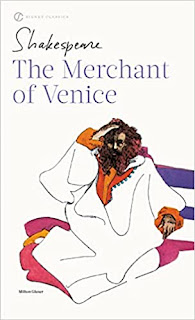
The Merchant Of Venice – William Shakespeare, c. 1596-1597 ★★★

Shakespeare's Thorniest Play

Shakespeare didn’t make this one easy. Try to enjoy The Merchant Of Venice as a crafty comedy, and you risk being insensitive. See it as a subversive tragedy, and you trip over author’s intent.

Pretend as many do that the play isn’t anti-Semitic, and there is still a lot of weirdness to navigate, like a rich dead father forcing his daughter to marry the first man who guesses which coffin hides her portrait, and a man so lustful and greedy he risks his best friend’s life to hook up with that daughter (we are supposed to root for this guy, by the way.)

As for me, I like it, even more once it gets going. I just don’t feel good about saying so.

Saturday, August 21, 2021

King John – William Shakespeare, c. 1596 ★★½

When Ruthlessness Fails

The more I read Shakespeare’s history plays, the more I feel I am watching a debate between the author and another Renaissance legend, Niccolò Machiavelli, over what constitutes effective leadership.

Is it better to be loved or feared? Is religion a useful prop, or something more meaningful and lasting? Is there such a thing as being too ruthless, or can one only err on the side of mercy?

Time and again, Machiavelli clearly states one thing; Shakespeare gently suggests quite another. Take Shakespeare’s King John.

Friday, February 26, 2021

The Merry Wives Of Windsor – William Shakespeare, c. 1597 ★★½

Forced Farce Still Amuses

Farce does not age like fine wine or mahogany furniture. But it can still draw a chuckle with the right mindset. Part of that involves some grounding in the material; more depends on not expecting too much.

With The Merry Wives Of Windsor, I find I enjoy it more accepting that it is a minor work. Critics do rate it fairly low in William Shakespeare’s oeuvre, a royal command sketch best known for its title and the way it uses (or misuses) Falstaff, one of comedy’s great characters.

All in all, though, as weak plays go, it’s actually not bad. It is chock full of loose ends and bad puns, yet it does put on an entertaining and diverting show, the final goal.

Monday, January 11, 2021

Henry V – William Shakespeare, c. 1599 ★½

Not Wild about Harry

King Henry V combines strident jingoism, weak comedy, structural instability, and some of Shakespeare’s dullest blank verse.

It also presents us with a windy protagonist who bears little resemblance to the saucy, shifting Prince Hal of the Henry IV plays. I find it a pain reading Henry V, except when the king is offstage, when it gets even more annoying.

What do so many other people see in this play anyway?

Sunday, November 8, 2020

Henry IV, Part II – William Shakespeare, c. 1597-98 ★★★

Tubby Takes a Hike

For decades, if not longer, many critics have argued that what you get in Henry IV, Part II is not a sequel but a clone.

Certainly you see Shakespeare reacting to the success of his first Henry IV play by giving audiences more of the same. More rebel plotting, more Prince Henry antagonizing the squares, and especially more hijinks from Sir John Falstaff, who proved a comic sensation in his debut.

Saturday, November 7, 2020

Henry IV, Part I – William Shakespeare, c. 1597 ★★★★½

A Prince by any Other Name

There is a Shakespeare quote that springs to mind when reading Henry IV, Part I, but not from that play. Rather, it’s from As You Like It.

“All the world’s a stage and all the men and women merely players; they have their exits and their entrances, and one man in his time plays many parts…”

In Henry IV, Part I, that man is Prince Henry, heir to the throne held by our title character. The Prince will play many parts in the course of his career, most notably two he develops in tandem here: a dissolute ruffian inspired by his friendship with the disgraced Sir John Falstaff; and a bold knight modeled on Hotspur, who leads an army against his father.

Saturday, September 26, 2020

Richard II – William Shakespeare, c. 1595 ★★★★

Bad King Makes Bad Choices

Kicking off the second and more famous of William Shakespeare’s “Henriad” history plays, The Tragedy Of Richard II makes the most sense when read after the three plays which chronologically follow it: Henry IV, Part 1; Henry IV, Part 2; and Henry V.

That’s because while this play is concerned with the same basic question, how to be a good king, it does by presenting a type of worst-case scenario the kings of the later plays take pains to avoid.

That is after the first of these Henrys caused the problem leading to that scenario. Or did he? Welcome to the conundrum that is Richard II.

Tuesday, May 26, 2020

A Midsummer Night's Dream – William Shakespeare, 1595-96 ★★★★

Love as a Mental Disorder

There is a book waiting to be written about literature’s worst employees. Near the head of this list I would like to nominate one Robin Goodfellow, better known as Puck of A Midsummer Night’s Dream.

After botching a big assignment, he has the cajones to look at his boss, no mere mortal but the fairy king Oberon, throw up his hands, and exclaim: “Lord, what fools these mortals be!”

Yet he doesn’t even get a reprimand, let alone a performance review. Just a mild “Stand aside” as Oberon sets about fixing Puck’s mess. Such is the ease of life as practiced in this easiest of Shakespeare’s plays.

Saturday, September 14, 2019

King Edward III – William Shakespeare & others, c. 1594 ★★½

Making a Case for Number 39

William Shakespeare is commonly credited with having written 38 plays, many if not most regarded as classics to this day. Why not make room for another?

The answer is an easy no if the play is not up to the standard one expects from the Bard of Avon. Much of the time this patriotism pageant unspools, the result is uneven, as more sensitive members of academia put it. But then you find yourself catching sparks of true genius and wit that, if not exclusive to Shakespeare, ring with his singular voice.

Did Shakespeare lend a hand? The evidence suggests a qualified yes.

Saturday, April 6, 2019

The Taming Of The Shrew – William Shakespeare, 1590-1592 ★★½

What's Askew About the Shrew?

Not every “classic” work of literature makes great reading. Sometimes a work is overrated, a little or a lot. Sometimes the text fails to connect to a particular reader. And sometimes, every once in a while, the classic label is not a function of the text itself, but rather the work’s place in our larger culture. You respect it, see its imprint, and sort of shrug.

That is my subjective take on The Taming Of The Shrew, a pleasant comedy that in my view, promises more than it delivers.