Showing posts with label Stephen Sears. Show all posts

Sunday, July 5, 2026

Lincoln’s Lieutenants – Stephen W. Sears, 2017 ★★★★

Epic Battles Led by Petty Minds

They were eventual victors in the highest-stakes battles their country ever fought, enduring gut-wrenching reversals and hellish casualties all the way. They were also whiny, bratty, narcissistic headcases easily triggered into launching dramas behind the front.

With such leaders was the Union saved.

The main takeaway from this book, the first by Civil War historian Stephen Sears to cover the entire war rather than a specific campaign, is just how brutal a spectacle it was not just during specific battles but all the way through. Yet the prima donna aspect hits home, too.

Friday, May 1, 2026

Gettysburg – Stephen W. Sears, 2003 ★★★★½

Teaching Lee Humility

It began a brazen demonstration of contempt and wound up a history-altering mistake. In between, over three days, came intense carnage. Still, who won Gettysburg was not decided immediately; much of the how and why parts of the battle are still being debated.

Today we see Gettysburg as the turning point in the bloodiest of American wars. Back then, concrete conclusions were harder to reach. Stephen W. Sears offers readers something the people who fought at Gettysburg didn’t have: clarity.

For the Confederates, what was at stake was clear enough. They needed to stay on the attack and put the fight to the North. The commander of their Army of Northern Virginia, Robert E. Lee, explained: “There is always hazard in military movements, but we must decide between the positive loss of inactivity and the risk of action.”

Monday, March 9, 2026

Controversies & Commanders: Dispatches From The Army Of The Potomac – Stephen W. Sears, 1999 ★★

War is Hell on Generals, Too

Throughout the first half of the Civil War, the U. S. Army on the field performed like beer-league backups against a team of All-Stars. It is natural a series of essays about its leadership would present a dispiriting chronicle of utter ineptitude. Mostly it does.

Stephen W. Sears, who has written about those early years of the Army of the Potomac across several campaign-specific books, takes stock of Northern leadership performance during the war as a whole. He would seem the right author; yet for all his expertise Controversies & Commanders is not as satisfying as his other works.

It may just be that much of this book is ground he covered before, in chapters of other books. Or the brevity of his essays, or the lack of their originality as he mostly plumbs secondary sources and offers non-controversial conclusions.

Saturday, November 22, 2025

Chancellorsville – Stephen W. Sears, 1996 ★★★

Slipping the Jaws of Victory

Initiative is a word you see a lot in military contexts. Aggressive generals seize it, unsuccessful ones fumble it, wargamers even roll for it. In Chancellorsville, Stephen W. Sears examines a major U.S. Civil War battle decided to an almost unfair degree by initiative.

On paper, it should have been a Union victory. Their usual advantage in numbers was increased when a key Confederate force was pulled away from Robert E. Lee’s command, giving the North a 2:1 edge in troops.

Learning from the mistakes of his Federal predecessors, Joseph Hooker tried something different from the usual frontal assault into entrenchments. He employed an ambitious sidelong thrust utilizing telegraph wire and secret river crossings. For a while, it was even working.

Saturday, September 24, 2022

To The Gates Of Richmond: The Peninsula Campaign – Stephen W. Sears, 1992 ★★★½

An Overlooked Bloodbath

Even for many American Civil War buffs, the Peninsula Campaign and its climactic Seven Days Battles are undiscovered country.

For concentrated blood and fury stretched out over an entire week, the Seven Days’ intensity is unrivaled. The Peninsula Campaign saw the first armored engagement – between the Merrimack and the Monitor – and the origin of “Taps,” yet people know the name “Bull Run” more than “Malvern Hill,” despite the latter’s higher body count and import.

Perhaps the campaign eludes easy comprehension because there wasn’t a clear winner. The North lost most of the battles, but the South lost most of the men. Fear trumped opportunity, while leaders of varying abilities all to varying degrees wilted under the spotlight.

Gettysburg it was not.

Saturday, March 5, 2022

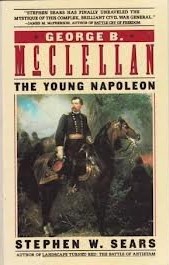
George B. McClellan: The Young Napoleon – Stephen W. Sears, 1988 ★★½

General Delay

Terrible military leaders grab history’s attention like a car wreck on the highway, albeit with a much higher body count. Whether as monuments of supreme idiocy or just poor luck, they live on in a way only the best of the good leaders do.

Think of Custer or Crassus or Conrad von Hötzendorf, who all married bad judgment and wanton disregard for life to leave us eternal reminders of the folly of war. There are others not as spectacular but every bit as deadly.

Take, for example, George McClellan, whose leadership can be blamed for extending the U. S. Civil War. This at least is the impression left by Stephen W. Sears in this biography of McClellan.

Monday, February 1, 2021

Landscape Turned Red: The Battle Of Antietam – Stephen W. Sears, 1983 ★★★★½

Playing Rope-A-Dope with “Tardy George”

Sometimes it takes a setback to produce victory, a nasty punch in the nose that restores focus and the will to win. It can even be a simple matter of attaining purity of purpose through suffering.

Still, if sounds unpleasant, that’s because it is. Such was the American Civil War’s bloodiest single day, the Battle of Antietam, presented here in a book that is equal parts morality play and combat story.