Showing posts with label American Civil War. Show all posts

Sunday, July 5, 2026

Lincoln’s Lieutenants – Stephen W. Sears, 2017 ★★★★

Epic Battles Led by Petty Minds

They were eventual victors in the highest-stakes battles their country ever fought, enduring gut-wrenching reversals and hellish casualties all the way. They were also whiny, bratty, narcissistic headcases easily triggered into launching dramas behind the front.

With such leaders was the Union saved.

The main takeaway from this book, the first by Civil War historian Stephen Sears to cover the entire war rather than a specific campaign, is just how brutal a spectacle it was not just during specific battles but all the way through. Yet the prima donna aspect hits home, too.

Friday, May 1, 2026

Gettysburg – Stephen W. Sears, 2003 ★★★★½

Teaching Lee Humility

It began a brazen demonstration of contempt and wound up a history-altering mistake. In between, over three days, came intense carnage. Still, who won Gettysburg was not decided immediately; much of the how and why parts of the battle are still being debated.

Today we see Gettysburg as the turning point in the bloodiest of American wars. Back then, concrete conclusions were harder to reach. Stephen W. Sears offers readers something the people who fought at Gettysburg didn’t have: clarity.

For the Confederates, what was at stake was clear enough. They needed to stay on the attack and put the fight to the North. The commander of their Army of Northern Virginia, Robert E. Lee, explained: “There is always hazard in military movements, but we must decide between the positive loss of inactivity and the risk of action.”

Monday, March 9, 2026

Controversies & Commanders: Dispatches From The Army Of The Potomac – Stephen W. Sears, 1999 ★★

War is Hell on Generals, Too

Throughout the first half of the Civil War, the U. S. Army on the field performed like beer-league backups against a team of All-Stars. It is natural a series of essays about its leadership would present a dispiriting chronicle of utter ineptitude. Mostly it does.

Stephen W. Sears, who has written about those early years of the Army of the Potomac across several campaign-specific books, takes stock of Northern leadership performance during the war as a whole. He would seem the right author; yet for all his expertise Controversies & Commanders is not as satisfying as his other works.

It may just be that much of this book is ground he covered before, in chapters of other books. Or the brevity of his essays, or the lack of their originality as he mostly plumbs secondary sources and offers non-controversial conclusions.

Saturday, November 22, 2025

Chancellorsville – Stephen W. Sears, 1996 ★★★

Slipping the Jaws of Victory

Initiative is a word you see a lot in military contexts. Aggressive generals seize it, unsuccessful ones fumble it, wargamers even roll for it. In Chancellorsville, Stephen W. Sears examines a major U.S. Civil War battle decided to an almost unfair degree by initiative.

On paper, it should have been a Union victory. Their usual advantage in numbers was increased when a key Confederate force was pulled away from Robert E. Lee’s command, giving the North a 2:1 edge in troops.

Learning from the mistakes of his Federal predecessors, Joseph Hooker tried something different from the usual frontal assault into entrenchments. He employed an ambitious sidelong thrust utilizing telegraph wire and secret river crossings. For a while, it was even working.

Saturday, August 5, 2023

A Stillness At Appomattox – Bruce Catton, 1953 ★★★½

A Somber Last Waltz

The third and final volume of Bruce Catton’s “Army Of The Potomac” series winds up the story of Abraham Lincoln’s greatest fighting force as it struggled to its ultimate victory. Like nearly all such grand culminations, it can’t help but be at least a little disappointing.

Part of that is due to the natural deflation of finding oneself at the end of a long journey, wondering if all the toil and pain was worth it. Part of it is because the last year of the American Civil War, at least in Northern Virginia, was as dull as it was deadly, mired in an early form of trench warfare which put an end to dashing assaults and quick successes.

The author is also at fault. Catton, for all his factual command, his poetic turns of phrase, and his masterful word portraits, comes across somewhat more the way critics have painted him, moralizing and windy. The book is still good, very good in places, but a modest comedown from the fantastic first two volumes.

Sunday, March 26, 2023

Glory Road – Bruce Catton, 1952 ★★★★★

Death Before Victory

War is hell, a fact even honest combat histories often sidestep. Not to deny its ugliness, but rather to craft a narrative palatable to a broader audience. Bitter reality is acknowledged, but details not dwelt upon.

Glory Road is different. It is the Saving Private Ryan of American Civil War histories, a blow-by-blow account of the terrors of war not for the squeamish. In his depiction of the Battle of Gettysburg, the war’s turning point, Bruce Catton describes a Bosch-like canvas where eyes are shot out, maddened horses gallop on three legs, and men duck bullets behind the bodies of dead comrades.

One soldier is so horribly maimed that he is described putting a gun to his head and blowing out his brains. Meanwhile, others are directed to throw themselves into an exposed position, just to buy a few precious minutes after one general had put his part of the line too far out.

Thursday, January 5, 2023

Mr. Lincoln’s Army – Bruce Catton, 1951 ★★★★½

Dying to Learn

Many books about the American Civil War begin with the Battle of Bull Run. Mr. Lincoln’s Army does, too, but not the normal way. It opens with the Second Battle of Bull Run, a contest which settled nothing except the plain fact the Northern Army was being run by idiots.

Ineptitude is a common theme of this first volume of a famous trilogy focused on the Army of the Potomac, specifically its painful struggle to find its feet and strike the decisive blow against the Confederacy.

It was all a question of leadership. “There would have been unqualified disaster if the generals had not been commanding men better than themselves,” Bruce Catton writes.

Saturday, September 24, 2022

To The Gates Of Richmond: The Peninsula Campaign – Stephen W. Sears, 1992 ★★★½

An Overlooked Bloodbath

Even for many American Civil War buffs, the Peninsula Campaign and its climactic Seven Days Battles are undiscovered country.

For concentrated blood and fury stretched out over an entire week, the Seven Days’ intensity is unrivaled. The Peninsula Campaign saw the first armored engagement – between the Merrimack and the Monitor – and the origin of “Taps,” yet people know the name “Bull Run” more than “Malvern Hill,” despite the latter’s higher body count and import.

Perhaps the campaign eludes easy comprehension because there wasn’t a clear winner. The North lost most of the battles, but the South lost most of the men. Fear trumped opportunity, while leaders of varying abilities all to varying degrees wilted under the spotlight.

Gettysburg it was not.

Saturday, March 5, 2022

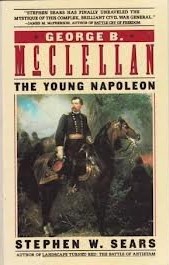
George B. McClellan: The Young Napoleon – Stephen W. Sears, 1988 ★★½

General Delay

Terrible military leaders grab history’s attention like a car wreck on the highway, albeit with a much higher body count. Whether as monuments of supreme idiocy or just poor luck, they live on in a way only the best of the good leaders do.

Think of Custer or Crassus or Conrad von Hötzendorf, who all married bad judgment and wanton disregard for life to leave us eternal reminders of the folly of war. There are others not as spectacular but every bit as deadly.

Take, for example, George McClellan, whose leadership can be blamed for extending the U. S. Civil War. This at least is the impression left by Stephen W. Sears in this biography of McClellan.

Friday, December 24, 2021

North And South – John Jakes, 1982 ★★

Too Thick for its Own Good

Why do big, thick fiction novels invest in me a sense of awe that smaller tomes do not? Do I not recall Hemingway’s thoughts on the value of concision? Or how a tight narrative framework often works best, even when the subject is the American Civil War?

You can fit The Red Badge Of Courage in your pocket or purse. Good luck trying that with North And South.

John Jakes followed up the amazing success of his eight-volume “Kent Family Chronicles” by kicking off what proved an even bigger commercial triumph, the story of two American families united in duty but driven apart by war and the “peculiar institution” known as slavery. The result is a hodgepodge of crafty plotting and loose writing, of flat characters and engaging storycraft.

Monday, February 1, 2021

Landscape Turned Red: The Battle Of Antietam – Stephen W. Sears, 1983 ★★★★½

Playing Rope-A-Dope with “Tardy George”

Sometimes it takes a setback to produce victory, a nasty punch in the nose that restores focus and the will to win. It can even be a simple matter of attaining purity of purpose through suffering.

Still, if sounds unpleasant, that’s because it is. Such was the American Civil War’s bloodiest single day, the Battle of Antietam, presented here in a book that is equal parts morality play and combat story.

Friday, September 8, 2017

And Tyler Too – Robert Seager II, 1963 ★★★½

Evaluating America's Imperfect 10

Try naming American presidents, and chances are good you stumble on “Tyler.” Was his first name “James” or “John?” Was he president before or after Millard Fillmore? The kids at Springfield Elementary School on “The Simpsons” once did a musical number about “caretaker presidents.” Sure enough, he gets a mention:

There’s Taylor/There’s Tyler/There’s Fillmore and there’s Hayes/There’s William Henry Harrison/‘I died in thirty days.’

Thursday, February 2, 2017

The March – E. L. Doctorow, 2005 ★★½

Trudging through Georgia

The American Civil War remains a touchstone for understanding what it means to be American. Whether it’s race and regionalism, human rights and civil liberties or westward expansion and technological progress, everything that makes America American runs through the Civil War like a teeming railroad junction or the mighty Mississipp.

No wonder so many American fiction writers take a shot at writing about it.

Wednesday, November 23, 2016

Wilkes Booth Came To Washington – Larry Starkey, 1976 ★★

Killing Lincoln: The 'Blame Canada Theory

Mystery still surrounds the assassination of Abraham Lincoln. It’s not about who did it; but why.

This 1976 account suggests Lincoln’s murder was a kind of Hail Mary pass by the Confederacy, designed to trigger an outsized reaction from the North that would force Great Britain into the U. S. Civil War. 

To this end, author Larry Starkey challenges the conventional view of Lincoln’s assassination. Why did John Wilkes Booth, a nationally-famous tragedian, affect such a rage-inducing scheme without any discernable escape plan? Why did he make sure people recognized him after he shot the President, both at Ford’s Theatre and later on when he crossed a bridge to escape Washington, D. C.?

Friday, September 4, 2015

The Lincoln Conspiracy – Timothy L. O'Brien, 2012 [No Stars]

Other Than That, Mrs. Lincoln...

Historical fiction is one of my favorite literary genres, when it’s done well. The spinning nature of time is never better appreciated than when one sees a page from our past come into focus as if for the first time.

A thoughtful fictional treatment can lend a fresh and divergent perspective on what has become well-trod ground.

But when historical fiction is done badly, it makes for a rough trudge. Take this story set in the United States after the Civil War, centering on the mystery surrounding the country’s first presidential assassination. As fiction, as history, as action-adventure, the novel fails so badly as to defy reason.

Thursday, October 23, 2014

Killing Lincoln – Bill O'Reilly & Martin Dugard, 2011 ★★½

Sic Semper Something-or-other

Does a work of popular history actually impede one's deeper understanding of the past? One might think so from the hoopla surrounding the original release of Killing Lincoln.


Across America, historians blasted Killing Lincoln for being a poorly-researched font of disinformation. Museum gift shops that sell Honest Abe coloring books determined it to be beneath their standards. The deputy superintendent of the Ford's Theatre National Historic Site in Washington, D. C. cited numerous errors and a lack of footnotes in recommending Killing Lincoln be kept off its book store shelves as a disservice to Lincoln's memory.

Meanwhile, the actual murder weapon used for killing Lincoln is on display at Ford's Theatre, under glass.